Loft conversions in Dudley
Most houses in Dudley sit outside its conservation areas, so a rear dormer within the permitted development limits needs no planning application. That matters here, because when an application is needed, Dudley Council's Residential Design Guidance SPD (2023) says dormers will only be permitted in very exceptional circumstances. Mushroom Green, the old nailmakers' hamlet at Dudley Wood, is the one conservation area in and around the town with an Article 4 direction.
- Planning authority
- Dudley Metropolitan Borough Council
- Conservation areas
- Dudley Town Centre (with parts of Ednam Road and St James's Road); Castle Hill; Mushroom Green
- Article 4 directions
- Mushroom Green (the direction boundary differs slightly from the conservation area)
- Typical houses
- Semis, terraces around Kates Hill and Netherton, the 1930s Priory estate
- Postcodes
- DY1 and DY2
A high bar for dormers that need permission
The Residential Design Guidance SPD, adopted on 28 June 2023, took in the council's older Housing Extensions guidance note. On dormers it is unusually firm: they will only be permitted in very exceptional circumstances, where they suit the architectural style of the house and match its existing features in proportion and position. Where one is accepted, smaller dormers are favoured, set back at least 1 metre from the eaves, and dormers already built nearby are not treated as a reason to approve an unacceptable scheme. Raising the roof to make a loft usable is judged against the rhythm of similar houses in the street.
None of this applies to a dormer that is permitted development, because no application is made. So for most Dudley houses the design starts with the national limits: 40 cubic metres of new roof volume on a terraced house, 50 on a semi, nothing on the roof slope facing the road, and the dormer set back at least 20 centimetres from the eaves where practicable. A Lawful Development Certificate confirms the position in writing before work starts.
Kates Hill terraces, the Priory estate and Mushroom Green
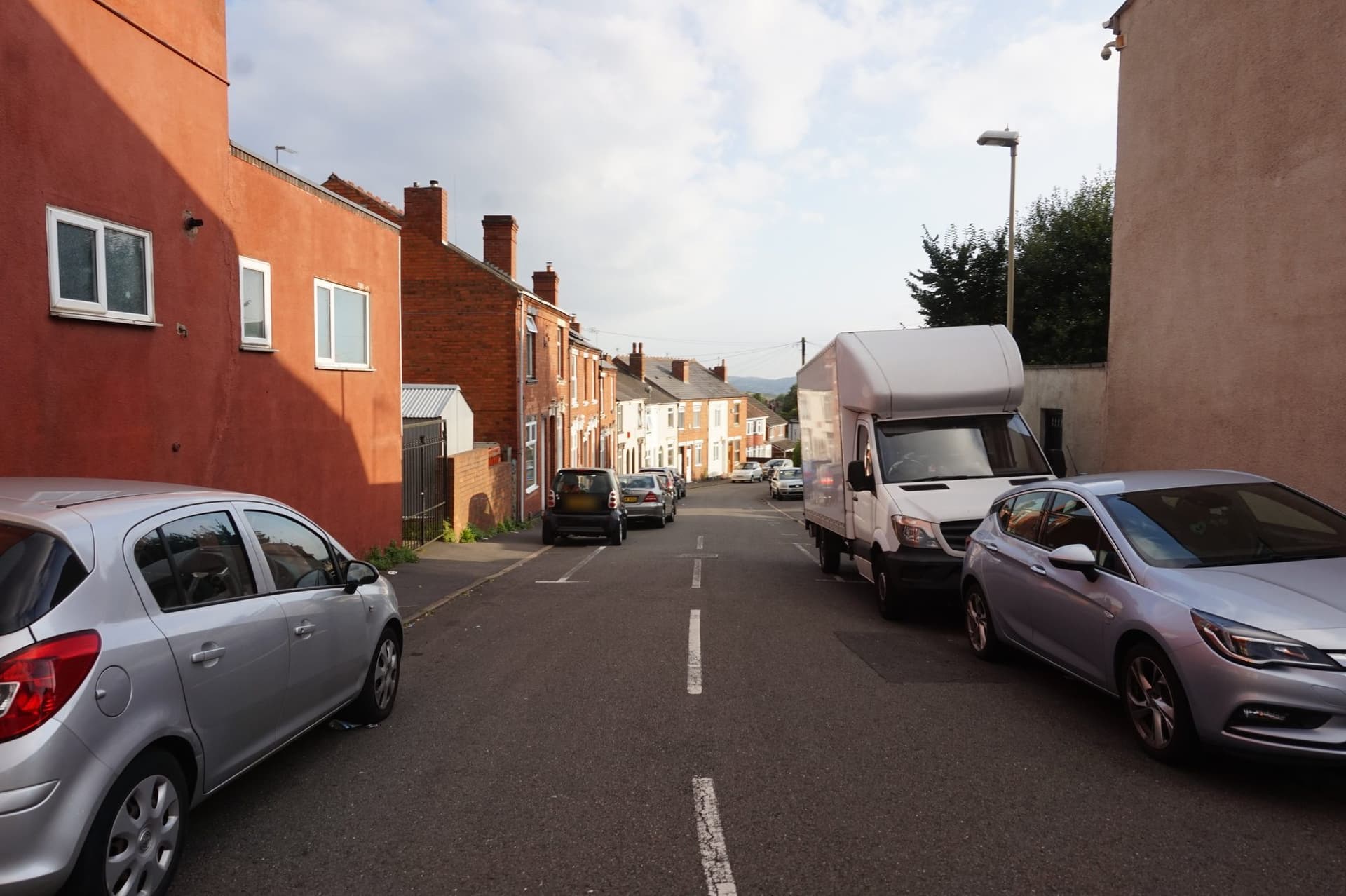
The council's borough-wide historic landscape study describes Kates Hill as a large area of late 19th century workers' housing on straight, narrow streets, and the streets around Blowers Green and Gamage Street as Edwardian workers' housing. In the 2021 Census about 23 per cent of households in the St Thomas's ward and in Netherton, Woodside and St Andrews lived in terraced houses, against 15 per cent across the borough. A terrace has the smaller 40 cubic metre allowance; where it has a two-storey rear outrigger, an L-shaped dormer can use both roofs.
The Priory estate was laid out in the early 1930s as a garden suburb to designs by Edward Prentice Mawson, with many semis and terraces set back behind long green verges, built to replace slum housing cleared from the town centre. Where one of its semis has a hipped roof, a hip-to-gable change with a rear dormer is the usual way to gain a full room. Closer to the centre, the late Victorian, Edwardian and interwar villas of Ednam Road and St James's Road form part of the Dudley Town Centre conservation area, where any roof extension needs planning permission.
Mushroom Green is different again. It began in the 18th century as a settlement of nailmakers on common land of Pensnett Chase, later turned to chain making, and became a conservation area in April 1970. Its Article 4 direction removes permitted development rights for extensions and requires an application for any material change to the outside of a building. The council's guidance note for the hamlet says its roofs are mainly clay tile with a steep pitch, a tradition it wants continued.
Questions from Dudley
Do I need planning permission for a dormer in Dudley?
Not if the house is outside a conservation area and the dormer stays within permitted development: 40 cubic metres of new volume on a terrace, 50 on a semi or detached house, and nothing on the front slope facing the road. If it does need an application, Dudley Council's design guide says dormers are only permitted in very exceptional circumstances, so it pays to design within the limits.
Is Mushroom Green covered by an Article 4 direction?
Yes. The direction removes permitted development rights for extensions there and requires a planning application for any material change to the outside of a building. Its boundary is not identical to the conservation area's, so check the council's map for your address.
Does Dudley's Householder Extensions LDO cover loft conversions?
No. The Local Development Order, adopted in October 2017, covers single-storey rear and side extensions, two-storey extensions and first-floor side and rear extensions. Dormers and roof extensions are not on its list, so a loft conversion goes through either permitted development or a planning application.
Ask about a loft conversion in Dudley
Give us the postcode and we will check the planning position for your street before we visit.